 Practical Guides
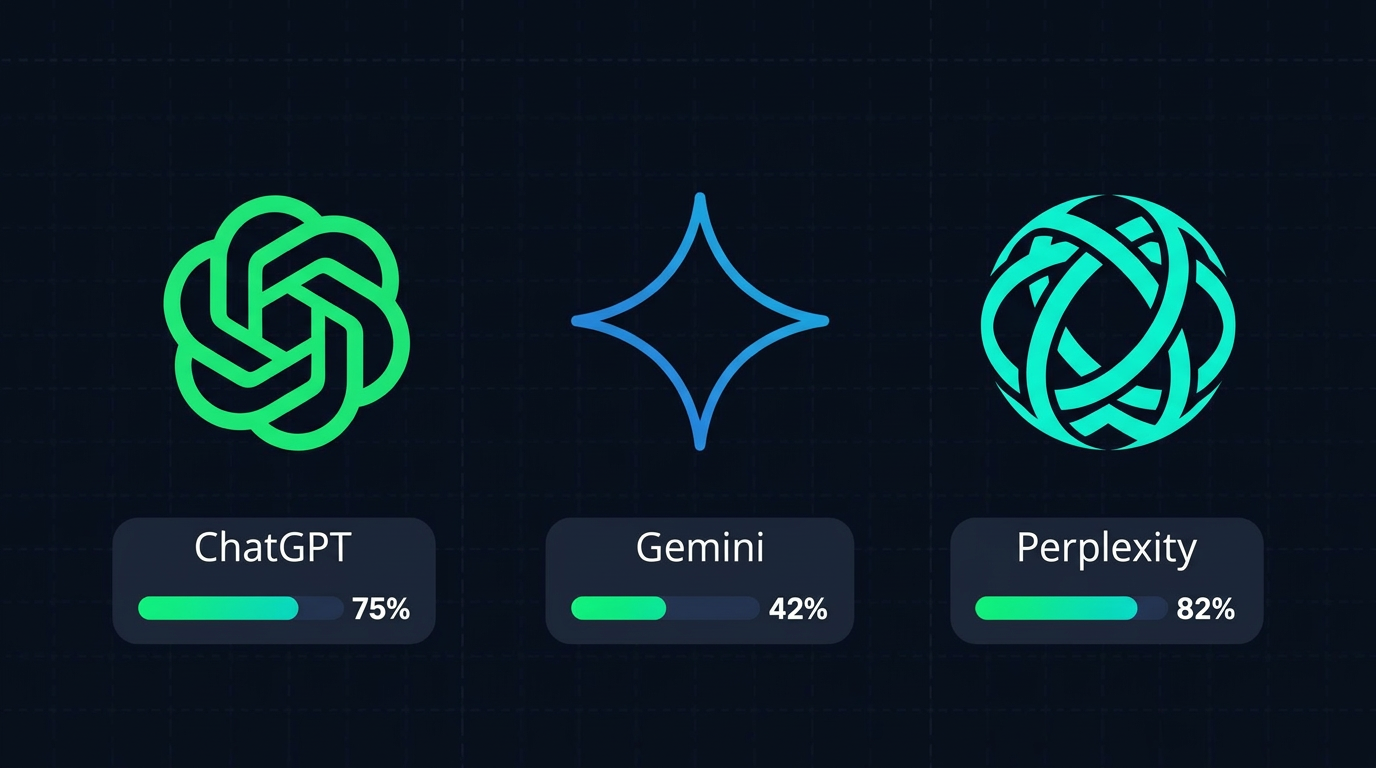
ChatGPT vs Gemini vs Perplexity: Which Recommends Your Brand
You can have a perfectly optimized website, reviews on every major directory, and quality backlinks — and still be invisible on Gemini while your competitor ranks first on ChatGPT.
That's not a bug. It's how these models work.
ChatGPT, Gemini, and Perplexity have different architectures, different data sources, and different signals they use to decide who to recommend. What works on one may not work on another. If you don't understand how each one decides, you're optimizing blind.
A Tinuiti study analyzing thousands of commercial queries across AI platforms confirms it: there is no universal primary source. Citation patterns vary drastically across models, sectors, and question types. Optimizing for one doesn't guarantee visibility on the rest.
This guide explains exactly how each model builds its recommendations — and what your brand needs to show up in each one.
How ChatGPT Decides Who to Recommend
ChatGPT (GPT-4o), with over 800 million weekly users, draws from two layers: training knowledge and real-time web access (when the user enables it). For brand visibility, training knowledge is the dominant layer: what OpenAI indexed before the model's data cutoff.
The practical implication: ChatGPT favors brands with strong presence in established authority sources. You need mentions in recognized publications, listings in high-traffic directories, reviews on platforms like Google Business, TripAdvisor, or Trustpilot, and consistency between what your website says and what external sources say.
What matters most for ChatGPT:
- Mentions in publications and blogs with high domain authority
- Reviews across multiple third-party platforms
- Consistent brand name across all sources (no variations)
- Schema markup that helps the model understand what your company does
- Content that answers specific industry questions (not just product pages)
What matters least for ChatGPT:
- Content freshness (training knowledge doesn't update in real time without browsing)
- Google ranking (a brand can be well-known in ChatGPT's training data without ranking high on Google)
The Browsing Factor
When a user enables browsing in ChatGPT, the model searches the web and can surface recent content. In this mode, traditional SEO factors gain weight. It behaves more like Perplexity.
How Gemini Decides Who to Recommend
Gemini has a unique advantage over the others: direct access to the Google ecosystem. That means Google Maps, Google Business Profile, Google Reviews, Google Shopping, and Google's search index all feed directly into its responses.
The practical consequence: your presence in Google's ecosystem matters far more for Gemini than for any other LLM. An incomplete Google Business Profile, sparse reviews, or weak SEO hurts you more in Gemini than in ChatGPT or Perplexity.
What matters most for Gemini:
- Complete and updated Google Business Profile (hours, photos, categories, description)
- Volume and quality of Google reviews
- Organic ranking on Google for relevant industry queries
- Schema markup (especially Organization, LocalBusiness, Product)
- Google Maps presence if you have a physical location
- Fresh, recently indexed content
What matters least for Gemini:
- Presence on review platforms outside the Google ecosystem (TripAdvisor, Trustpilot) carries less weight than in ChatGPT
- Mentions in external media not reflected in the Google index
Why Gemini Can Surprise You
Because Gemini is connected to the Google index in real time, it's the fastest model to reflect changes. Publish new content today, Google indexes it tomorrow, and Gemini can incorporate it in days. That also means technical SEO issues — duplicate content, broken canonicals, non-indexed pages — affect you more in Gemini than in the other models.
AI Overviews: Gemini's Extension Inside Google
When someone searches on Google and sees an AI-generated summary above the organic results, that's Gemini at work. AI Overviews are appearing in a growing share of searches worldwide. If your brand isn't cited there, you're losing visibility in both traditional and generative search — and a drop in Gemini usually anticipates a drop in AI Overviews.
How Perplexity Decides Who to Recommend
Perplexity works differently from both. It functions as a conversational search engine: every time someone asks a question, Perplexity runs real-time web searches, extracts the most relevant fragments, and builds a response with explicit citations and direct links.
Two key implications. First: Perplexity always cites its sources. If you appear in Perplexity, the user sees a link to your website. It's the only model of the three where visibility generates direct, verifiable traffic. Second: traditional SEO factors carry more direct weight here than in ChatGPT or Gemini, because the quality of web search results directly feeds the response.
What matters most for Perplexity:
- Ranking in web search results for sector queries
- Content freshness (prioritizes recent, indexed content)
- Clear content structure (headings, lists, concrete data that's easy to extract)
- Presence in sources Perplexity considers reliable (media, specialized blogs, directories)
- Fast indexation speed
What matters least for Perplexity:
- Training knowledge (every query starts with a fresh search)
- Mentions in sources without indexable web presence
Claude: The Quiet Analyst
Claude, by Anthropic, has fewer users than ChatGPT or Gemini but a strong professional base in research, analysis, professional services, and tech companies. If your target customer is a technical or B2B profile, Claude matters more than its global share suggests.
Claude tends to give more nuanced answers and lean less on "brand list" formats than ChatGPT. When it recommends, it contextualizes more and is more cautious with absolute claims. That means your brand may appear less frequently but with more credibility when it does.
What matters most for Claude: deep, well-argued content, sources with authority and E-E-A-T signals, sector analyses, and technical documents. What matters least: "top 10" listicle tactics.
Grok: The Model Connected to X
Grok, by xAI, has one feature no other model offers: direct, real-time access to posts on X (Twitter). If your brand publishes relevant content on X consistently, Grok can cite you in contexts where the other models wouldn't.
Its overall market share is still smaller than ChatGPT or Gemini, but it's worth monitoring if your audience is active on X or if you operate in sectors where the conversation lives on that platform (media, technology, finance, politics).
Comparison Table: ChatGPT vs Gemini vs Perplexity for Brands
| Factor | ChatGPT | Gemini | Perplexity |
|---|---|---|---|
| Primary source | Training knowledge | Google index + training | Real-time web search |
| Real-time web access | Optional (browsing) | Yes (always) | Yes (always) |
| Cites sources with links | Sometimes | Sometimes | Always |
| Generates direct traffic | Rarely | Rarely | Yes |
| Content freshness weight | Low (without browsing) | High | Very high |
| Traditional SEO weight | Medium | High | Very high |
| Google ecosystem weight | Low | Very high | Medium |
| Media mentions weight | Very high | High | High |
| Google reviews weight | Medium | Very high | Medium |
| Update speed | Slow | Fast | Immediate |
What Strategy to Follow to Appear in All Three
The good news: the fundamentals overlap. You don't need three completely separate strategies. You need a solid foundation and then model-specific adjustments.
Foundation that works across all three:
- Consistent brand name across all platforms (website, directories, social, media)
- Correct schema markup (Organization, Product or Service based on your business type)
- Presence in authoritative media and sources in your industry
- Structured content that answers specific questions (not just product pages)
- Positive reviews across multiple platforms
Model-specific adjustments:
To improve on ChatGPT: focus on earning mentions in high-DA publications, industry reference directories, and diverse review platforms. Long-term brand consistency matters more than freshness.
To improve on Gemini: prioritize your Google Business profile, Google reviews, and technical SEO. Indexation issues hurt you more here than anywhere else.
To improve on Perplexity: invest in fresh, well-structured content that ranks in the top positions for industry queries. Perplexity follows the SEO trail more directly than the other models.
Where Should I Focus Based on My Business Type?
Priorities shift depending on your business model. Here are the most practical focus areas:
Local businesses (restaurants, clinics, hotels, services with a physical location): prioritize Gemini — Google Business, Google reviews, and local SEO — and Perplexity for local directories and reviews. ChatGPT is secondary for queries with local intent. See how GEO works for hospitality →
Ecommerce and online brands: prioritize Gemini (Google Shopping, structured product data) and ChatGPT, which now integrates direct purchase via Instant Checkout. Perplexity contributes on comparison queries. See GEO for ecommerce →
SaaS and technology: prioritize ChatGPT (G2/Capterra reviews, sector media) and Claude, used by technical and decision-maker profiles. Perplexity for fresh content and comparisons. See GEO for SaaS →
Agencies and professional services: prioritize ChatGPT (authoritative media, indexed case studies) and Perplexity (up-to-date content demonstrating expertise). Gemini complements with traditional SEO. See GEO for agencies →
How to Know Where You Have the Most Room to Improve
The only way to know with real data is to analyze your visibility in each model separately. Manual testing isn't enough: responses vary between queries, the questions you ask determine the outcome, and without a systematic analysis you can't track trends or benchmark against competitors.
Mentio analyzes your brand simultaneously across ChatGPT, Claude, Gemini, Grok, and Perplexity using prompts tailored to your industry. The report shows your visibility broken down by model, your average position in each, and the gaps versus your competition — so you know exactly where the biggest opportunity is.
Analyze your visibility across 5 LLMs →
In Summary
ChatGPT, Gemini, and Perplexity are not interchangeable. Each has its own sources, its own criteria, and its own trust signals. Understanding how each one works isn't a technical detail — it's the difference between optimizing strategically or investing time in the wrong signals.
If you want to know which of the five you're weakest in right now, the fastest way is a visibility analysis that measures them all at once. Mentio is built natively for brand visibility, not a bolt-on SEO module — and returns a model-by-model report in under two minutes.
Want to know if AI mentions your brand?
Discover your visibility in ChatGPT, Claude and Gemini in minutes.
Related articles
How to Measure Your Brand's AI Visibility: Metrics, Tools and Step-by-Step Guide
Learn how to measure if ChatGPT, Gemini and Perplexity mention your brand. Guide with key metrics, tools and steps to analyze your AI visibility.
GEO BasicsAI SEO: Complete Guide to Position Your Brand in ChatGPT, Gemini and Perplexity
Learn how to optimize your brand to appear in ChatGPT, Gemini and Perplexity. Complete AI SEO guide with GEO, AEO and LLMO strategies updated for 2026.
Practical Guides5 Mistakes That Make AI Ignore Your Brand (And How to Fix Them)
Your brand doesn't appear in ChatGPT or Gemini. These are the 5 most common mistakes and how to fix them to improve your AI visibility.